BIENVENIDOS AL NUEVO BLOG PARA COMPARTIR RECURSOS Y EXPERIENCIAS

Este blog nace con el objetivo de ser una fuente de recursos para las clases de lenguas extranjeras.
Si deseas enviar material, no lo dudes:
blogdeprofes@gmail.com
Todavía estamos empezando ;)
Mostrando entradas con la etiqueta speaking. Mostrar todas las entradas

18/3/11

School time!


Este cómic puede servirnos para introducir el tópico da escuela y las asignaturas en clase de inglés. Además de reforzar el vocabulario relacionado con la descripción física. 

What should I purchase?

Students will listen to commercials on the radio, watch them on television, and read advertisements in the newspapers, magazines, and "junk mail" received at home. This activity can be done individually, in pairs, or in teams.
Have a dialogue about commercials and focus on how and why they are successful in getting people to buy certain products, cars, and foods. How are these commercials able to convince people that they should spend their vacations in a particular country or on a certain island? Ask students why their parents shop at a specific clothing or food store and why they purchase certain brands of blue jeans, shoes, or other items.
Have students read advertisements. Have them select key words or distinctive phrases that catch their attention or appeal to them. They are to make a list of these words and phrases and discuss the reasons for their selections.
Using these key words and phrases as a guide, the students are to select an existing product or create one and write their own "persuasive TV commercials." Each student or team member will present their commercial orally, using their oratorical skills to convince the class that their particular product should be purchased.

10/3/11

An image to think about and discuss in class

Topic: Globalisation
Describe the image. What can you see in the image? What is your opinion about it? Do you think that it is a good representation of the reality? Why?

What is happening?

A good comic in order to be described using present continuous :)

Speaking in class

Greetings:
All students start milling about the room. Ask them to greet each other,
perhaps just by shaking hands or saying hello. Students just shake hands, move on, and greet the next
student they meet. Then ask the students to greet each other in a more specific way.
Possibilities are: like a lost friend, like someone you don’t really trust, someone you
hate, an ex-boyfriend or ex-girlfriend, someone you are secretly in love with, someone
with bad breath.


by Lindsay Clandfiel

28/2/11

website with all kind of exercises :)

Check it! Readings, writing, listening, speaking...

super-powers

Wouldn't it be great to have super powers? If you could have one super power, which one would you choose?

This is an excellent warm-up to introduce "conditionals".

ice-breaker!

 Room 101
• Ask each person to name three things they really dislike and wish they could lock away into Room 101 forever. I sometimes start the ball rolling myself as students may need a few moments to think of the things they really wish they could lose from their lives. Put them in common and choose one to lock away into Room 101 forever. 


16/2/11

role-play

Strangers on a train
This is an excellent activity to promote oral fluency practice & specific language practice at the same time.
Get the students to imagine they are strangers in a train compartment - get them sitting opposite each other in groups of four. Elicit what people usually talk about on the train - the weather, where they are going/coming from etc. Tell them you are going to give them a line to memorise & that it's secret - give them out, students memorise & you take them back in.
Then explain what they have to do - to say their lines as naturally as they can in the conversation without the others guessing it is their line. So they have to direct the conversation so that they can say their line naturally, without the others noticing. They must have one conversation & not split into two as the others will miss their lines when they come to say them.
The lines you give them could contain a language item that you have recently been looking at or off-the-wall sentences (eg. My girlfriend sleeps in the garden). I had to do this in a Spanish lesson when I first started learning the languiage & my line was 'yo tampoco' - 'me neither' - so I had to wait for a negative to say my line.
At the end the students then tell each other what they thought were each others' lines. It's an activity that you can use again & again & it's lots of fun!

11/2/11

Find your partner...

The teacher prepares SELF-ADHESIVE TYPEWRITER ADDRESS LABELS.

Each label contains a real person's name or the name of a character from fiction or television cartoons. Each named person should have a natural partner, for example if you write a label with the name ROMEO, there should also be a label with the name JULIET stuck on somebody's back. If you have an odd number of students in your class, stick a label on your own back, but let the students do the questioning.


Questions must be of the type that can either be answered with YES or No:
Am I man or a woman? Alive or dead? European or American? Real or fictitious?
Am I a character from a cartoon or a book? Am I rich? Am I famous?
Have I been in the news recently? Am I someone from your country? Britain?
Do I work in sport / music / entertainment / the cinema / the theatre?


ROMEO
JULIET
TOM the cat
JERRY the mouse
POPEYE
OLIVE OIL
Prince Philip
Queen Elizabeth II
Micky Mouse
Minnie Mouse
Stan Laurel
Oliver Hardy
King Juan Carlos
Queen Sofia
André Agassi
Steffi Graff
Nelson Mandella
Winnie Mandella
John Lennon
Yoko Ono
Richard Burton
Elizabeth Taylor
Bonnie (gangster)
Clyde (gangster)
Tarzan
Jane (jungle girl)
The Lone Ranger
Tonto (cowboy)
Prince Charles
Princess Diana
Cinderella
Prince Charming

Simon says..

Simon says (Action verbs + Parts of the body)


Students should only obey the commands if you preface each one with Simon says. If you omit the preface Simon says any student who obeys the command can no longer participate in the game. The last student to remain in the game is the winner.

Simon says: "hands up", "hands down", "thumbs up", "thunbs down", "fingers up", "fingers down".
Simon says: "touch your eyes / ears / nose / mouth with the forefinger / middle finger / ring finger / little finger / of your (right)(left) hand.
Simon says: "put your right hand / left hand / both hands on your right / left knee."
Simon says: "shut / open your eyes", "stand up / sit down", "stand on your right / left leg".
Simon says: "bend your knees / body", "straighten your knees / body".
Simon says: "fold your arms", "put your arms by your side".
Simon says: "wave your right hand", "STOP", "jump up and down", "STOP".
Simon says: "point at the ceiling / floor with the forefinger/ middle finger / ring finger / little finger / of your right / left hand.

10/2/11

Asking for personal details...

SPEAKING 
We have some hypothetical new students in class. The teacher is going to pick three students to play the new students and the rest have to ask for their personal details.
This exercise is good for reviewing descriptions, verbs in present simple, have got, etc.
They have to ask simple questions about nationality, personality, likes and dislikes, hobbies, reason why they moved, etc.
Here you have the cards for the hypothetical new students. 

Maja
Age: 14 years old
Country: Poland
Nationality: Pole
Languages: English, Spanish and Polish
Likes: Swimming and dancing
Dislikes: Maths and videogames
Family: Mum, dad, two sisters and a dog
Reason why she moved: Her father’s job

Santiago
Age: 15 years old
Country: Portugal
Nationality: Portuguese
Languages: Portuguese, Spanish and English
Likes: football and street dance
Dislikes: Homework, French
Family: A dad and a sister.
Reason why he moved: They start a new life
Claire
Age: 14 years old
Country: US
Nationality: American
Languages: English and Spanish
Likes: Internet and pets
Dislikes: Salsa and cooking
Family: Grandparents, mum, sister, three pets.
Reason why she moved: her grandparents wanted to live in Spain

9/2/11

Are you a good friend? /¿Eres un buen amigo?

Aquí tenéis dos versiones (la inglesa y la española) de dos test de la amistad para alumnos con un nivel entre A2 Y B1. Es apropiado para realizar en San Valentín. 
Here you have two versions of the friendship test (Spanish and English). Level A2-B1. It's good for St. Valentine's day

¿Eres un buen amigo?

El test de los amigos en San Valentín
1.      Tu amigo no ha hecho los deberes. ¿Qué haces?
a)      Te ríes (0)   b)Le dejas copiar tus deberes(3)           c) Se lo dices a la profesora(0)
2.      Es el cumpleaños de tu amigo. Tú…
a)      Le compras un regalo (3)   b) Le dices “felicidades” (1)        c)Te olvidas (0)
3.      Tu amigo se ha olvidado la comida. Tú…
a)      Compartes (Partager) la tuya (3)   b) Comes tu comida delante de él (0)
   c)Le das dinero (1)
4.      Tu amigo te envía un sms mientras ves tu programa de televisión favorito.
a)      Ignoras el sms  (0)        b) Hablas con tu amigo            (3)        c)Le dices que te llame después (1)
5.      Tienes una nota muy buena en un examen, pero tu amigo ha suspendido. Tú…
a)      Le ayudas en el próximo examen (3)    b)Le dices que es tonto (0)   c)Le dices que no se preocupe (1)
6.      Estás jugando al fútbol y tu amigo se cae. Tú…
a)      Sigues jugando y marcas gol (but) (0)    b)Paras y ayudas a tu amigo (3)    c) Golpeas el balón (1)
7.      Si un amigo te presta (prêter) dinero, tú…
a)      Olvidas devolvérselo (rembourser) (0)    b)Se lo devuelves en un mes (1)    c)Se lo devuelves rápido (3)
8.      A un chico al que no conoces bien se le cae la mochila al suelo, tú…
a)      Le ayudas a recogerla (3)   b) Golpeas la mochila (0)      c)Lo ignoras (0)
9.      Tú mejor amigo está de vacaciones, tú…
a)      Le envías sms todos los días (3)    b) Encuentras otro amigo (0)     c)No piensas en él/ella (0)
10.  ¿Cuántos amigos tienes?
a)      Cientos (0)        b)Un gran grupo (1)       c) Unos pocos amigos especiales (3)

24-30 puntos- ERES UN AMIGO EXCELENTE
20-23 puntos. ERES UN BUEN AMIGO PERO PUEDES SER MEJOR
12-19 puntos  PODRIAS SER MEJOR AMIGO SI LO INTENTAS
1-11 puntos ¿TIENES ALGÚN AMIGO?

Chain Spelling (Shiri-tori)

Chain Spelling (Shiri-tori)

Level: Easy to MediumThe teacher gives a word and asks a student to spell it, and then a second student should say a word beginning with the last letter of the word given. The game continues until someone makes a mistake, that is, to pronounce the word incorrectly, misspell it or come up with a word that has been said already, then he/she is out. The last one remaining in the game is the winner.
This game can be made difficult by limiting the words to a certain category, e.g.. food, tools, or nouns, verbs, etc.
Submitted by: Huang Shufang

Speaking in class


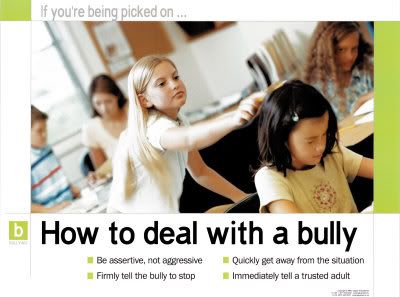
I propose some images to talk about bullying in class. It can be a good way to work on imperatives in English. We can encourage students to design some posters for the school. We also can use this activity to discover if we have this kind of problem in our school and to talk about that and about other problems such as violence, racism, etc. 


8/2/11

The new student role-play

click on the link: role-play


This is a role-play activity in which your students practise asking for and giving personal details and directions.
Level: Elementary and above
Description
Role-play is a great way for students to try out their English. Most of my students love having the chance to use their language in a realistic way, and often take the role-play much further than I would have thought possible! The quieter students also come out of themselves, their 'new identities' giving them the confidence to speak.
In this role-play, one student is the receptionist of a language school in London and the other is a new student. Each student has a 'role card' which details the information they need to find out from their partner and also the answers that they will give to their partner.
The 'receptionist' needs to find out the name, age, telephone number etc. of the new student. The 'new student' needs to find out the address and directions to the school from the nearest train stop. The receptionist's role card has a simple map which they must describe to the new student. Registration cards and blank maps are provided for students to complete with the information they find out. (If photocopying is an issue, ask your students to use their own notepads to jot down their answers rather than making these additional cards for them.)


enhance your creative writing skills!

For each picture, do the exercise detailed below, to enhance your creative writing skills. You can do it orally too.
  • Describe the picture in detail
  • Write three questions for the photos (For example:  Why are the women in the street?
  • Why did the photographer take this picture?
  • If this were a picture from a movie, what would the name of the movie be? (Use your imagination)
  • What happened just before this picture was taken?
  • What happened just after this photo was taken?
  •  What colors can you see in this picture?  Try to look up unusual shades in the dictionary.
  • Describe the character and personality of any one of the people in the photos.

BINGO!!! B-I-N-G-O!!

El juego del bingo es útil en cualquier clase de lenguas extranjeras. Os dejo un enlace a una página web dedicada al español que dispone de un montón de juegos para imprimir. Estos juegos, especialmente los bingos, nos pueden servir para cualquier clase de LE independientemente de la lengua que sea.
HAZ CLICK: BLOG CON JUEGOS